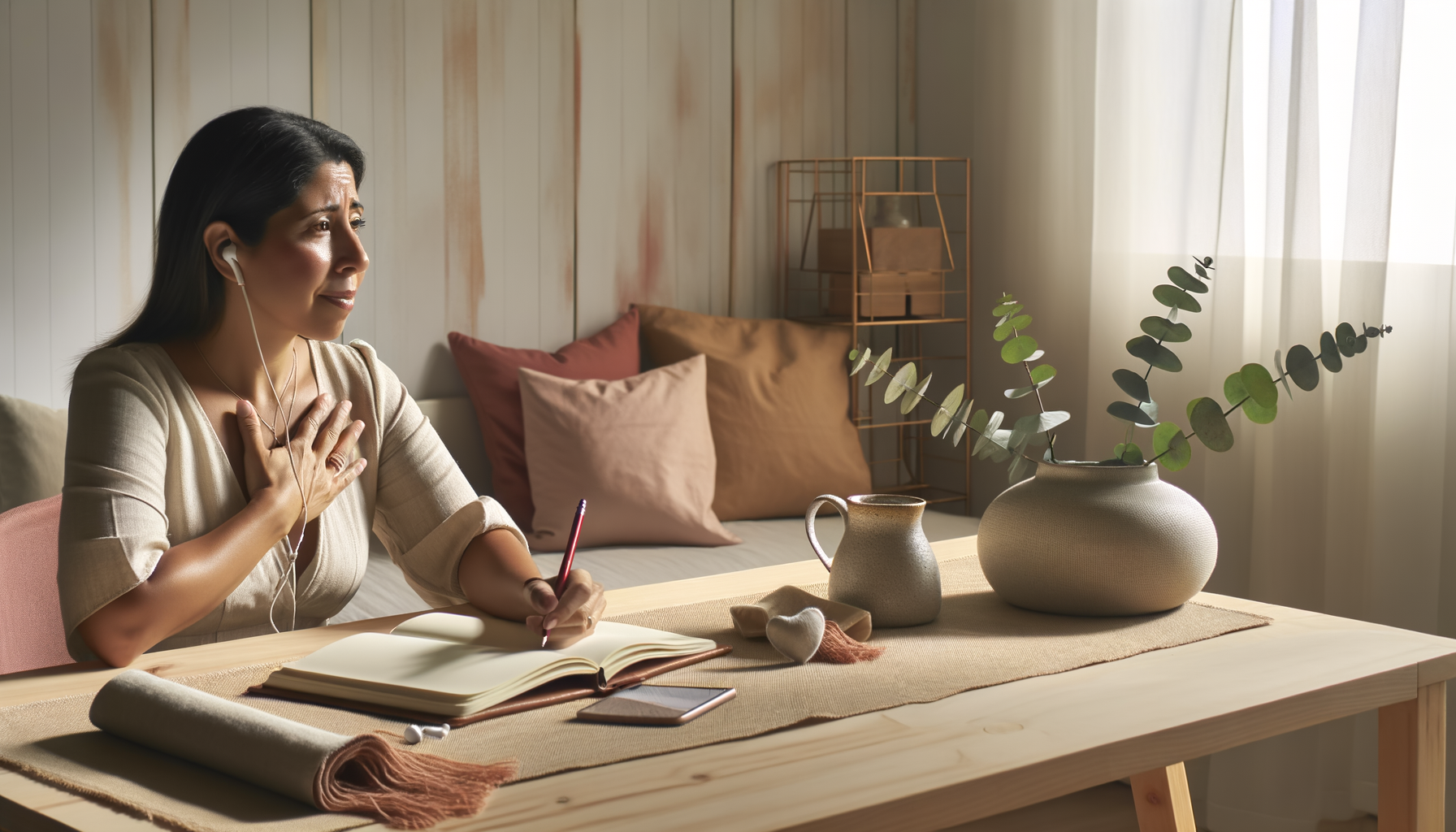

“The next time someone tells you to ‘just calm down,’ remind them that your anxiety isn’t a switch you can flip—it’s a signal your body is sending because it’s trying to protect you from something real.”
Sis, if one more person tells you to “just breathe” while your heart is racing so fast you can feel it in your ears, I swear. That advice is about as useful as telling someone drowning to “just swim harder.” Your anxiety isn’t a character flaw. It’s not you being dramatic. And it’s definitely not something you can snap out of because someone said the magic words “calm down.”
Here’s what nobody tells you: anxiety is your brain’s faulty alarm system. It’s wired to protect you from danger, but sometimes it goes off when you’re just sitting in class, staring at a tuition bill, or waiting for a text back from someone you really like. And when that alarm goes off, your body floods with cortisol and adrenaline—actual chemicals that make you feel like you’re dying. So no, you cannot “just calm down” any more than you can “just stop” having a fever.
I’ve been there. I’ve spent nights lying awake replaying every awkward thing I said in a conversation from three years ago. I’ve canceled plans because the thought of walking into a room full of people made my stomach hurt. I’ve Googled “am I having a heart attack or is it anxiety” so many times that my phone probably thinks I have hypochondria. And every single time, someone told me to relax. Like I hadn’t thought of that. Like I was choosing this.
Why “Just Calm Down” Is Literally the Worst Advice for Anxiety
When someone tells you to calm down, what they’re really saying is “your feelings are making me uncomfortable, so please stop having them.” It dismisses everything you’re experiencing and puts the blame on you for not being able to control it. But here’s the thing—anxiety isn’t a choice. It’s a physiological response. Your amygdala (that tiny part of your brain that processes fear) is literally sending out emergency signals. Your body is in fight-or-flight mode. You can’t reason your way out of a biological response.
And the research backs this up. According to the Anxiety and Depression Association of America, anxiety disorders are the most common mental health condition in the United States, affecting over 40 million adults. That’s 40 million people who have been told to “just relax” at some point in their lives. 40 million people who know that advice is garbage. You are not broken. You are not alone. And you are not behind everyone else who seems to have their life together.
40 MILLION adults in the U.S. have an anxiety disorder. You are not the only one feeling this way.
Let that sink in. You are not weird. You are not weak. You are one of millions of people whose brains are wired to be hyper-aware of potential threats. And in a world where we’re constantly bombarded with bad news, social media comparisons, and the pressure to have everything figured out by 25, is it really surprising that your brain is on high alert?
What Your Anxiety Is Actually Trying to Tell You
Here’s something I wish someone had told me when I was 19 and crying in my dorm bathroom before a presentation: your anxiety is not your enemy. It’s a messenger. And if you stop trying to shut it up and start listening to what it’s saying, you can actually use it to your advantage.
Most of the time, your anxiety is pointing at something you care about deeply. You’re anxious about that job interview? It’s because you actually want the job. Your stomach is in knots about a conversation with your roommate? It’s because you value the friendship and don’t want to mess it up. Your heart is pounding before you send that risky text? It’s because you’re putting yourself out there, and that takes courage.
The problem isn’t the anxiety itself. The problem is that nobody taught us how to decode it. We just get told to “breathe” and “meditate” and “try yoga” like those are magic cures. And while those things can help in the moment, they don’t address the root cause. They don’t teach you how to actually work with your anxiety instead of against it.
💡 Quick Tip
Next time you feel that wave of anxiety coming, pause and ask yourself one question: “What am I actually afraid of right now?” Not the surface answer like “I’m afraid of failing.” Get deeper. “I’m afraid that if I fail, people will think I’m not good enough.” That’s the real fear. Name it. Write it down. Once you name it, it loses some of its power over you.
What Actually Works When Your Anxiety Hits
Okay, so now that we’ve established that “calm down” is useless, let me give you actual tools that work. These aren’t fluffy suggestions. These are things I’ve used myself and things that therapists actually recommend. And yes, some of them might feel weird at first, but I promise they’re more effective than counting to ten.
First: ground yourself using the 5-4-3-2-1 method. Name 5 things you can see, 4 things you can touch, 3 things you can hear, 2 things you can smell, and 1 thing you can taste. This forces your brain to shift from the panic loop in your head to the actual physical world around you. It works because it engages your senses and interrupts the anxiety spiral before it takes over completely.
Second: cold water. Splash cold water on your face or hold an ice cube in your hand. The shock of cold triggers what’s called the “mammalian dive reflex”—it literally slows down your heart rate and activates your parasympathetic nervous system. That’s the system responsible for calming you down. It’s not a mental trick; it’s biology.
Third: move your body. I know when you’re anxious, the last thing you want to do is get up and move. But anxiety is energy trapped in your body. If you don’t release it, it stays there and builds up. Jump up and down. Do ten jumping jacks. Shake your hands out aggressively. Run in place for 30 seconds. This physically burns off the cortisol and adrenaline that are flooding your system.
💊 What Works: The Anxiety and Phobia Workbook by Edmund Bourne – This isn’t some fluffy self-help book. It’s a practical workbook with actual exercises, worksheets, and step-by-step strategies for managing anxiety. I wish someone had handed this to me in college. It’s been a game-changer for so many women in our community.
The Truth Nobody Tells You About Anxiety
Here’s the real talk that no one is going to tell you in a wellness Instagram post: anxiety doesn’t go away forever. It’s not a cold that you recover from. It’s more like a chronic condition that you learn to manage. And that’s okay. The goal isn’t to never feel anxious again. The goal is to stop being afraid of your anxiety. To stop letting it control your decisions. To learn how to feel the fear and do the thing anyway.
I remember being so terrified of public speaking in college that I almost dropped a class because we had to give a presentation. I actually went to my professor’s office hours and told her I was thinking of dropping. She looked at me and said, “You’re not dropping. You’re going to do the presentation, and you’re going to survive it. And then you’re going to realize that the anticipation is worse than the actual thing.” She was right. I did it. I was shaking the whole time. My voice cracked. I forgot a few points. But I survived. And the next time, it was a little easier.
“The anticipation of anxiety is almost always worse than the anxiety itself. Your brain is a storyteller, and it loves writing horror movies about things that haven’t happened yet.”
That’s the thing about anxiety—it lives in the future. It’s always projecting worst-case scenarios that haven’t happened and probably won’t happen. Your brain is trying to protect you by imagining every possible disaster so you can prepare for it. But in doing so, it robs you of the present moment. It makes you miss out on things because you’re too scared to show up.
How to Actually Deal With Anxiety in Real Life Situations
Let me break this down by specific situations you’re actually dealing with, because “just manage your anxiety” is too vague. You need concrete steps for real-life moments.
When you’re anxious about a job interview or presentation: Prepare, but don’t overprepare to the point of exhaustion. Write down three key points you want to make. Practice them out loud once or twice. Then stop. The more you rehearse, the more you’re feeding the anxiety by telling your brain “this is a huge deal.” It’s not a huge deal. It’s a conversation. You’re just talking to another human being. They’re probably nervous too.
When you’re anxious about a text or social situation: Set a timer for 10 minutes. Give yourself permission to feel the anxiety for exactly 10 minutes. Worry about what they think. Reread the text. Overthink the tone. But when the timer goes off, you’re done. You send the message and put your phone face down. You don’t check it for at least 30 minutes. This trains your brain that anxiety has a time limit, not an infinite loop.
When you’re anxious about money or tuition: Write down exactly what you’re afraid of. “I’m afraid I won’t be able to pay for next semester.” Then write down what you can actually do about it right now. Apply for one scholarship. Call the financial aid office. Ask about payment plans. Anxiety thrives on vagueness. The moment you turn a fear into a specific action item, it shrinks.
Why This Works:
✅ It gives your brain a specific task instead of a vague fear to spiral about.
✅ It shifts you from passive worry to active problem-solving.
✅ It reminds you that you have agency, even when you feel powerless.
The Hidden Link Between Anxiety and Your Physical Health
Here’s something I wish someone had told me years ago: your anxiety might not just be in your head. It could be connected to what’s happening in your body. Hormones, gut health, sleep, and even what you eat can all trigger or worsen anxiety. And nobody talks about this because it’s easier to just say “you need therapy” (which you might, and that’s okay too).
Your gut and your brain are literally connected through something called the vagus nerve. That’s why when you’re anxious, you might feel nauseous or get stomach aches. It’s also why what you eat can affect your mood. Caffeine, for example, mimics the physical symptoms of anxiety—racing heart, jitters, restlessness. If you’re already prone to anxiety, drinking coffee can feel like pouring gasoline on a fire. I’m not saying you have to give it up completely, but maybe try cutting back and see how you feel.
Sleep is another huge one. When you’re sleep-deprived, your brain’s ability to regulate emotions goes way down. You become more reactive, more irritable, and more prone to anxiety spirals. If you’re running on four hours of sleep and wondering why your anxiety is through the roof, that’s probably a big part of the answer. Your brain needs rest to function properly.
And your cycle—yes, your menstrual cycle—can absolutely affect your anxiety. In the week before your period, your body is more sensitive to stress. Your anxiety might spike for no apparent reason, and then you get your period and suddenly feel fine. That’s not in your head. That’s hormonal. Track your cycle and see if there’s a pattern. Knowing that it’s hormonal can help you stop blaming yourself and just ride the wave.
When to Get Professional Help for Your Anxiety
Okay, let’s talk about this because I know there’s a voice in your head that’s saying “but what if my anxiety is actually bad enough that I need help?” And I want you to hear this clearly: getting help is not a sign of weakness. It’s a sign that you’re smart enough to know when you need support. If your anxiety is keeping you from doing things you want to do, if it’s affecting your grades or your relationships or your ability to enjoy life, that’s a sign that you might need more than self-help strategies.
Therapy is not just for people with “serious” mental health issues. It’s for anyone who wants to understand themselves better and learn tools to cope. And if you’re a college student, you probably have access to free or low-cost counseling through your school’s health center. Use it. That’s what it’s there for. I promise you, the therapist has seen it all. You are not going to shock them with your story.
Medication is also an option, and it’s not something to be ashamed of. I have friends who take SSRIs for anxiety, and they say it’s like someone turned down the volume on their internal alarm system. They can still feel anxious, but it’s not overwhelming anymore. It’s a tool, just like therapy is a tool. You get to decide what tools work for you.
You don’t have to hit rock bottom to deserve help. If you’re struggling, you’re worthy of support right now.
The One Thing That Changed Everything for Me
I want to leave you with one thing that completely shifted how I relate to my anxiety. I stopped trying to get rid of it and started treating it like a part of me that was trying to help. I started saying “thank you, brain, for trying to protect me, but I’ve got this.” It sounds ridiculous, I know. But there’s actual science behind it. When you fight your anxiety, you create more stress. When you accept it and let it be there without judging it, it actually loses its grip on you.
You are not broken for feeling anxious. You are human. And in a world that asks so much of young women—to be perfect, to be successful, to be thin, to be liked, to have it all figured out—it makes sense that your brain is overwhelmed sometimes. Give yourself some grace. You’re doing the best you can with what you have.
And the next time someone tells you to calm down? Feel free to tell them that you’re actually handling it pretty well, considering. Or just walk away. You don’t owe anyone an explanation for your feelings.
This is the kind of stuff women talk about inside TechMae every single day. No judgment, just real ones keeping it real.
Related: This post is a must-read for women on their journey.
Start Here
One thing you can do right now: open your phone’s notes app and write down one thing you’re anxious about. Just one. Then write down the absolute worst thing that could happen if that thing goes wrong. Then write down the most likely thing that will actually happen. I bet the most likely outcome is way less scary than the worst-case scenario your brain cooked up.
Why This Works:
✅ It forces your brain to differentiate between catastrophic thinking and reality.
✅ It gives you perspective when you’re stuck in the anxiety spiral.
✅ It’s a concrete action you can take in under 5 minutes.
You might also love this article – one of our most shared.
This Is Your Sign to Stop Doing It Alone
Women inside TechMae have been exactly where you are. Come find your people.